




| 
|
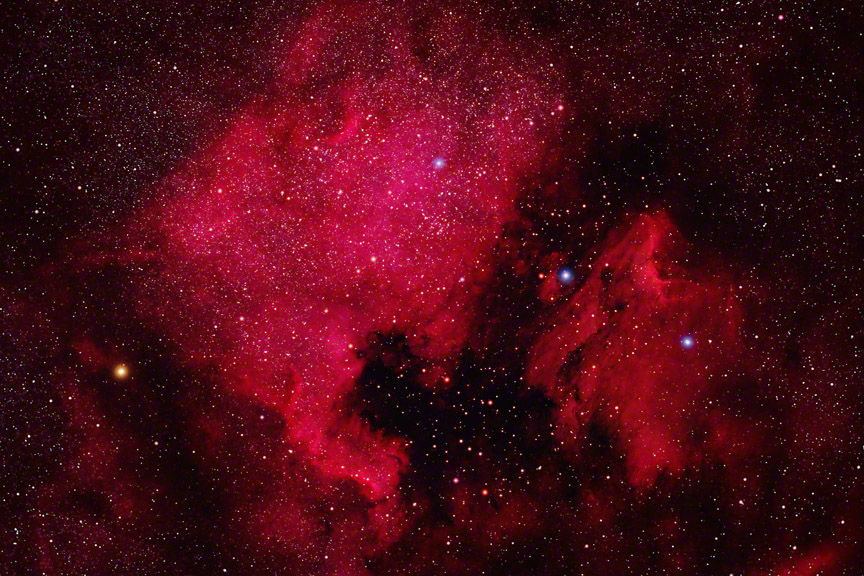
Clouds of glowing gas stand at the top of the Northern Cross in Cygnus. The dark band between the "east coast" and the Pelican is partially formed by obscuring dust and gas.
Astro-Physics 105mm (4.1 inch) refractor at f4.5. Three twenty-five minute exposures on gas-hypersensitized Kodak Supra 400 color negative film. August 8, 2002 from Speculator, NY. © 2002
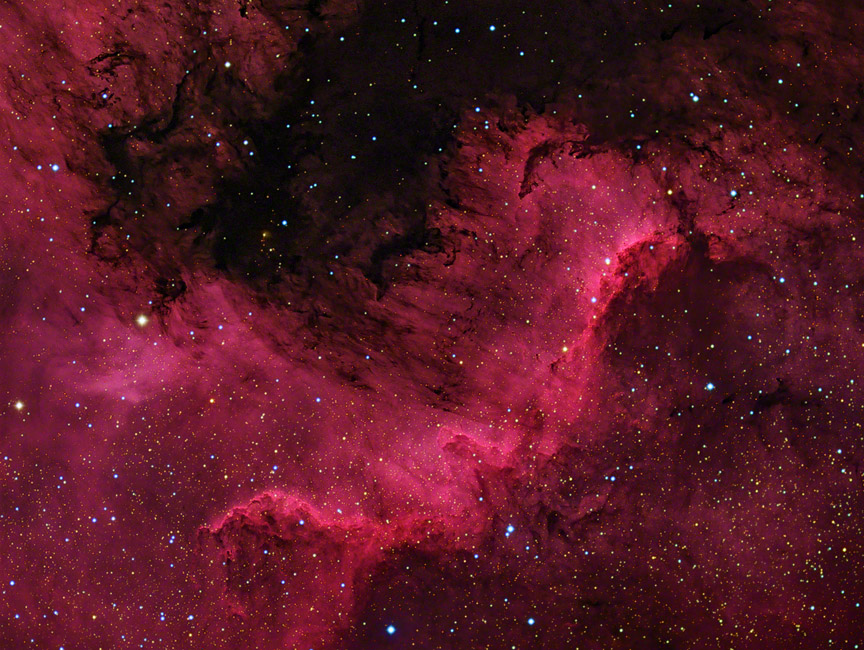
Detail of bright and dark nebulae in the southern portion of the North America Nebula (rotated to the left 90° ). The "Gulf Coast" is formed by a dark nebula between us and the bright nebula that forms the "Pacific Coast".
120 minutes L and 120 minutes RGB on 2015-09-06 plus 160 minutes H-a using an Astrodon 3 nm H-a filter on 2013-09-19 (blended with L and R), all using a QSI 583 from northern New Jersey through an Astro-Physics 155mm refractor at f5.4. North is to the left. ©2015
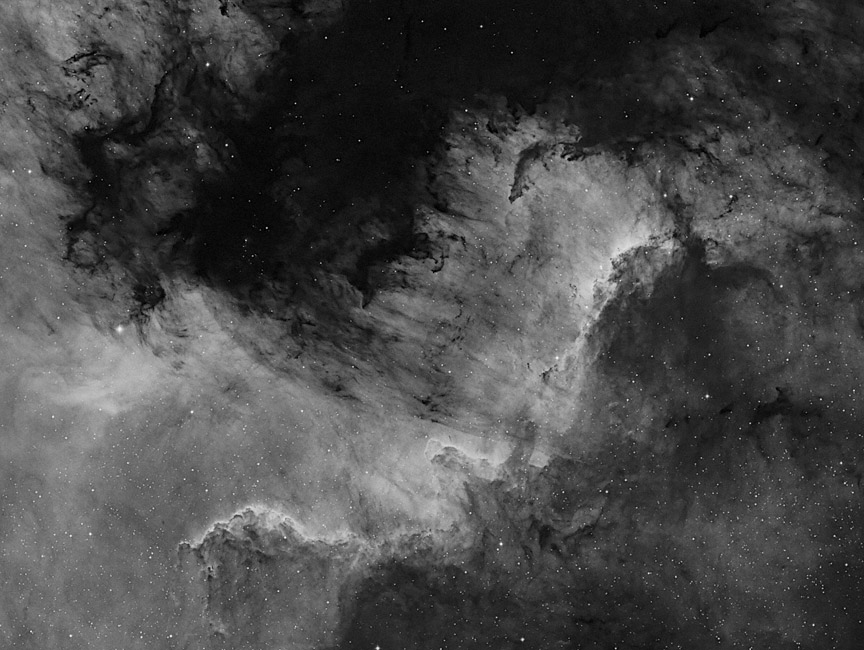
Detail of bright and dark nebulae in the southern portion of the North America Nebula (rotated to the left 90° ) in hydrogen-alpha light. The "Gulf Coast" is formed by a dark nebula between us and the bright nebula that forms the "Pacific Coast".
160 minutes on 2013-09-19 using an Astrodon 3 nm H-a filter with a QSI 583 from northern New Jersey through an Astro-Physics 155mm refractor at f5.4. North is to the left. ©2013
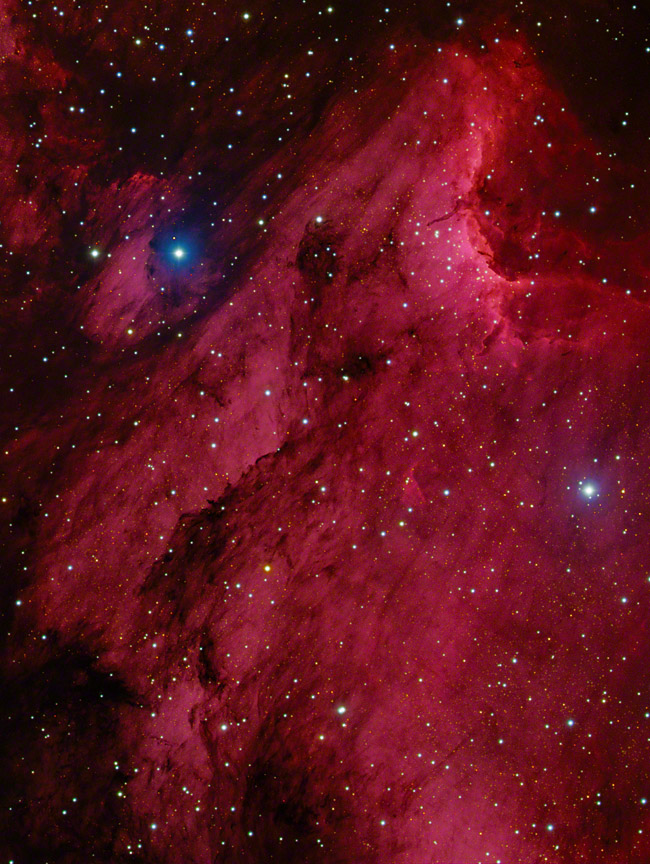
The Pelican Nebula is part of a larger complex of glowing hydrogen gas and dark dust clouds that includes the North America Nebula. The Pelican is cataloged as IC 5070. The next image shows it in hydrogen-alpha light.
120 minutes L and 120 minutes RGB on 2015-09-14 plus 240 minutes H-a using an Astrodon 3 nm H-a filter on 2011-11-07 (blended with L and R), all using a QSI 583 from northern New Jersey through an Astro-Physics 155mm refractor at f5.4.North is up. ©2015
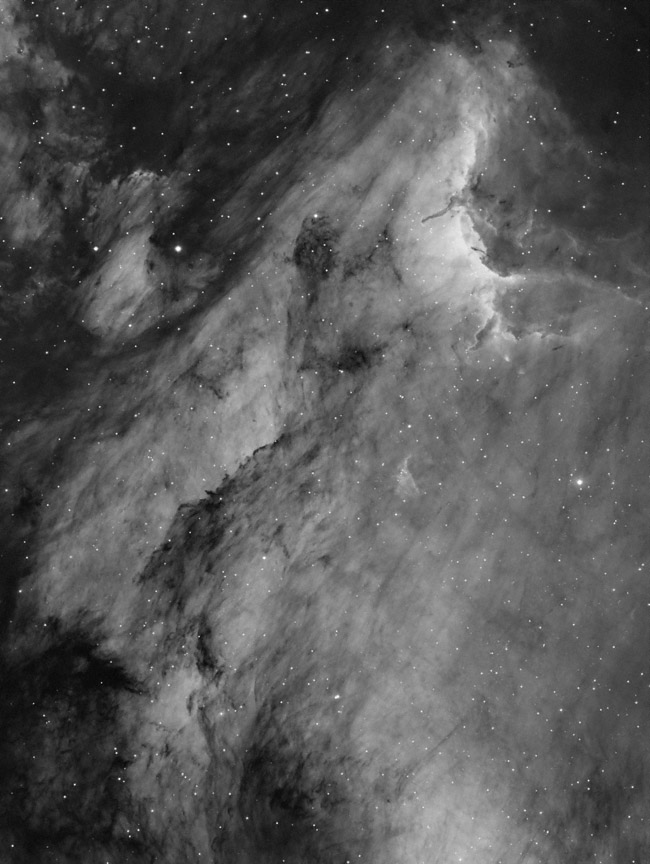
The Pelican Nebula is part of a larger complex of glowing hydrogen gas and dark dust clouds that includes the North America Nebula. The Pelican is cataloged as IC 5070. Details of the dark globules at the back of the pelican's "head" are shown below.
Astro-Physics 155mm refractor at f5.4. 240 minutes through an Astrodon 3 nm H-a filter using a QSI 583 on 2011-11-07 from northern New Jersey. North is up. ©2011
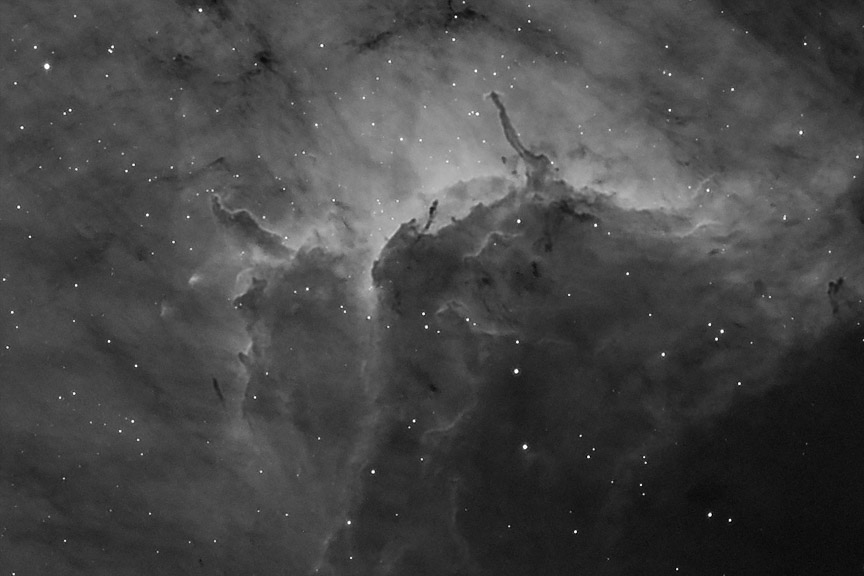
Dark globules and "elephant trunks" on the edge of the Pelican Nebula, a detail from the above image. This region is separately cataloged as IC 5067 and is about 2000 light-years away. Similar elephant trunks can be seen in CED 214, the Eagle nebula, NGC 6820, and IC 1396.
Near the tip of the tallest dark pillar, bipolar jets can be seen emerging from a hidden new star that formed in the depths of the globule. The jets bend westward in the stellar wind from the hot star that has ionized this entire region. The jets are cataloged as Herbig-Haro HH555 and are marked in the detail shown below.
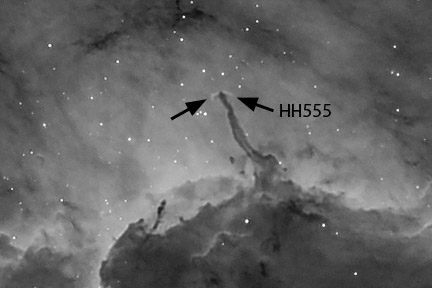
Detail with the HH555 jets marked.
| |||||||||||||||||
|
Astrophotography Books – Astronomy Books |