




| 
|
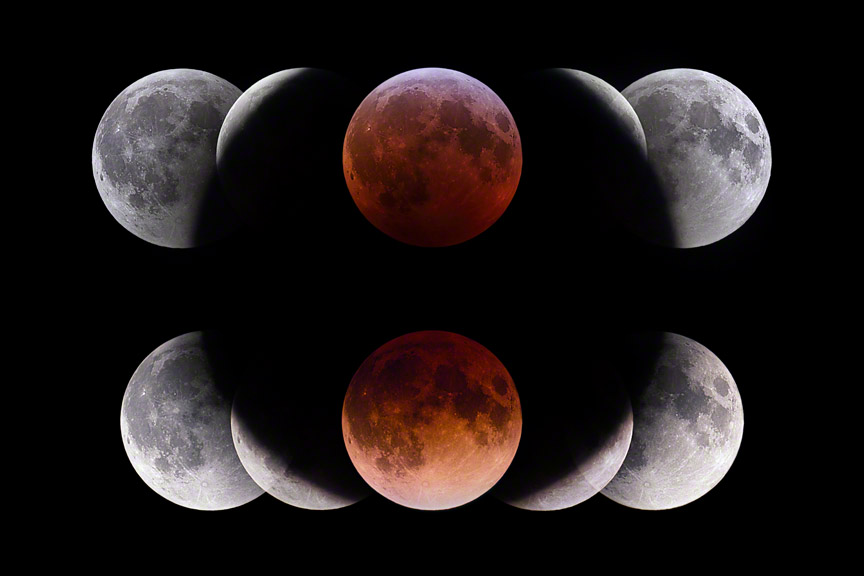
Earth's shadow was revealed as the Moon passed through its northern edge during the total lunar eclipse of January 20 & 21, 2019 and through its southern edge during the total lunar eclipse of November 8, 2003. The upper sequence is a composite of 5 images taken 40 minutes apart centered on mid-eclipse at 12:13 a.m. EST on January 21, 2019. The lower sequence is a composite of 5 images taken 40 minutes apart centered on mid-eclipse at 8:20 p.m. EST on November 8, 2003.
All images of the Moon are positioned relative to the center of Earth's shadow, which was moving across the star background as the Moon moved through it. In 2019, the Moon was near perigee and moving more rapidly in its elliptical orbit around Earth than in 2003. As a result, the individual images of the Moon ended up spaced a bit farther apart in the upper sequence.
In both sequences, the center image, taken with the Moon fully in shadow, shows the color of Earth's shadow. The shadow isn't totally dark because Earth's atmosphere acts as a lens and bends light into it. The light is tinted red as it grazes Earth's atmosphere, just as in sunsets. The fully eclipsed Moon is about 1,000 times dimmer than the fully sunlit Moon. In 2019, the Moon crossed a bit deeper into the center of Earth's shadow (the Umbra) than in 2003.
The size of the Moon was scaled to be the same in both sequences in the above image. The Moon's orbital plane is horizontal in both.
The next image below shows the apparent size of the Moon on the sky in both eclipses.
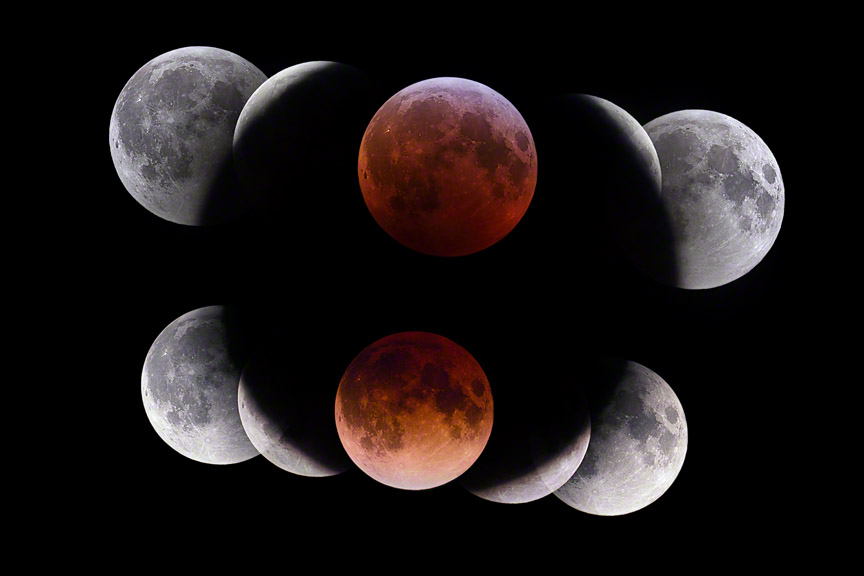
This image shows photos from the same two lunar eclipses as the image above, but here they are scaled to show the apparent size of the Moon on the sky. During the 2019 eclipse, the Moon was near perigee, the closest it gets to Earth, while during the 2003 eclipse, the Moon was near apogee, the farthest it gets from Earth. 2019's eclipse was a "Super-Moon," at 357,718 km away, and 2003's was a "Micro-Moon," at 405,608 km away. The Moon's apparent size differed by over 13% in the two eclipses, as did the apparent size of Earth's shadow where the Moon crossed it. (The shadow was also slightly smaller where the Moon crossed it in 2003 because it tapers away from Earth in space.) Both sequences are positioned with the Moon's north pole up.
The next image shows the orientation of the Moon relative to Earth's axis.
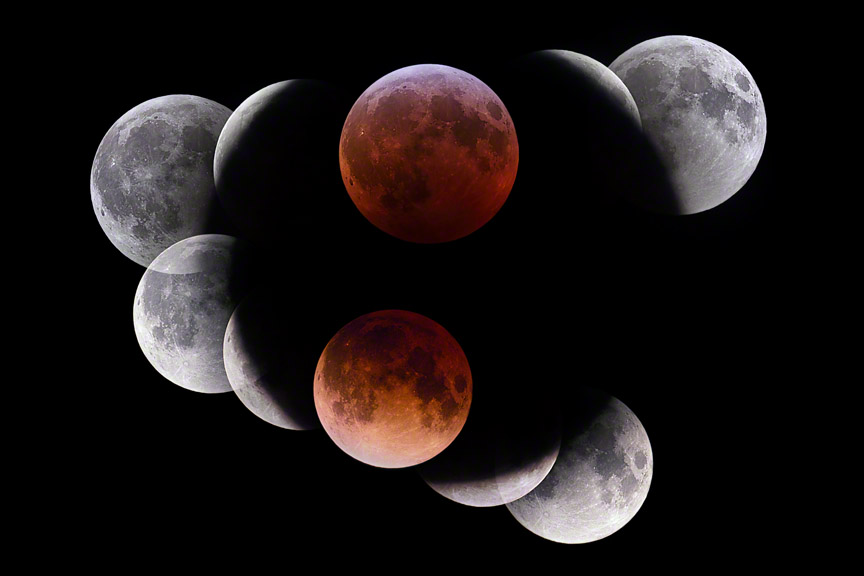
Like the other two images above, this image shows Earth's shadow as it was revealed during the total lunar eclipses of January 20/21 2019 and November 8, 2003. Here, the two eclipse sequences are oriented with Earth's north pole up and scaled to match their apparent size on the sky.
The orientation of the Moon in all the above sequences is complicated by the dynamics of the Earth-Moon system. The Moon's orbital plane around Earth is inclined 5.14° to Earth's orbital plane around the Sun. The Moon's axis is tilted 6.68° with respect to its orbital plane around Earth, while Earth's axis is tilted 23.4° with respect to its orbital plane around the Sun. The Moon's orbital path is elliptical and everything, including us, is in motion. As a result, the choice of how to arrange the above eclipse sequences is somewhat arbitrary. I've chosen the three arrangements above to 1) show Earth's circular shadow clearly, 2) to show the variation of the apparent size of the Moon, and 3) to show how the view shifts from the pivoting vantage point of the Earth.
Separate views of each eclipse sequence follow below, along with exposure information. All photos were taken through the same telescope using full-frame cameras.
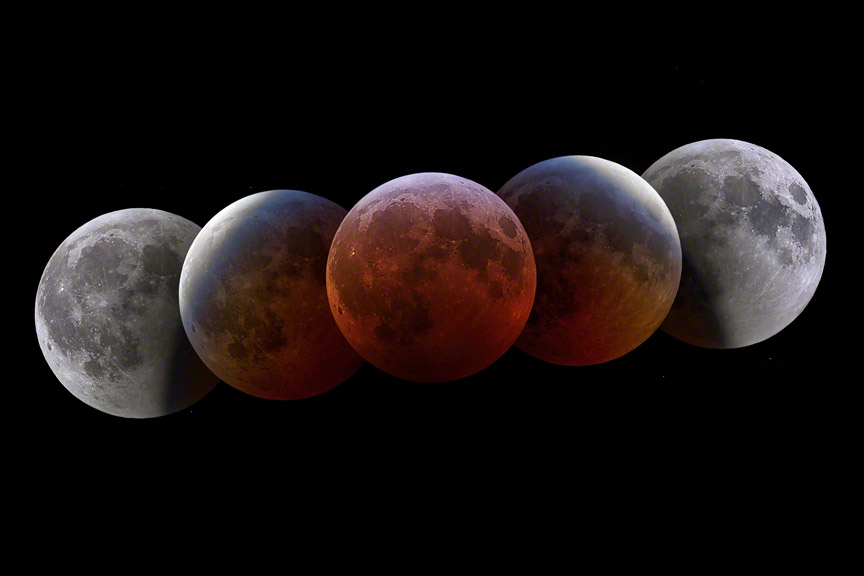
The total lunar eclipse of January 20/21, 2019. This photo is a composite of 5 sets of images taken 40 minutes apart centered on 12:13 a.m. EST. The partial phases were processed using "high dynamic range" (HDR) techniques to compress the brightness range and show the dim portion of the Moon inside the Umbra. The light in the Umbra is mostly tinted red as it grazes Earth's atmosphere, just as in sunsets, although the edge of the shadow is tinted blue by ozone in Earth's upper atmosphere. All images of the Moon are positioned relative to the center of Earth's shadow with Earth's north pole up. A few stars captured during totality can be seen.
Compare this image to the next one, which was made from the same photos, but was processed without any HDR dynamic range compression.
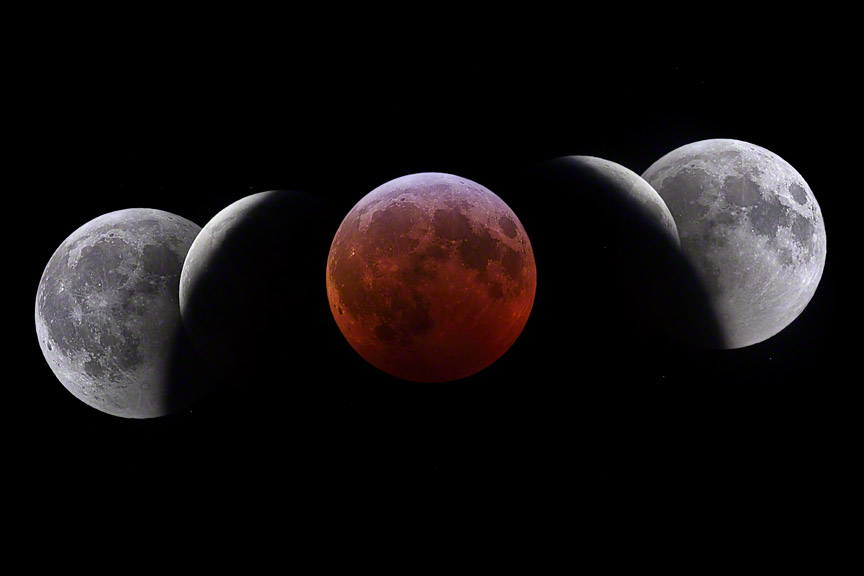
The total lunar eclipse of January 20/21, 2019. This photo is a composite of 5 images taken 40 minutes apart centered on 12:13 a.m. EST. The exposure at the center of totality was 1,000 times longer than the exposures of the Moon outside the Umbra. All images of the Moon are positioned relative to the center of Earth's shadow with Earth's north pole up. They are shown at the same scale as the image below of the 2003 eclipse. A few stars captured during totality can be seen.
Astro-Physics 155mm (6 inch) refractor at f7.1 using a Canon 5DIII from northern New Jersey centered at 2019-01-21 12:13 a.m. EST, +/- 40 and 80 minutes. Exposures range from 1/1000 seconds to 1 second at ASA 800. All images were taken from northern New Jersey. North is up. ©2019
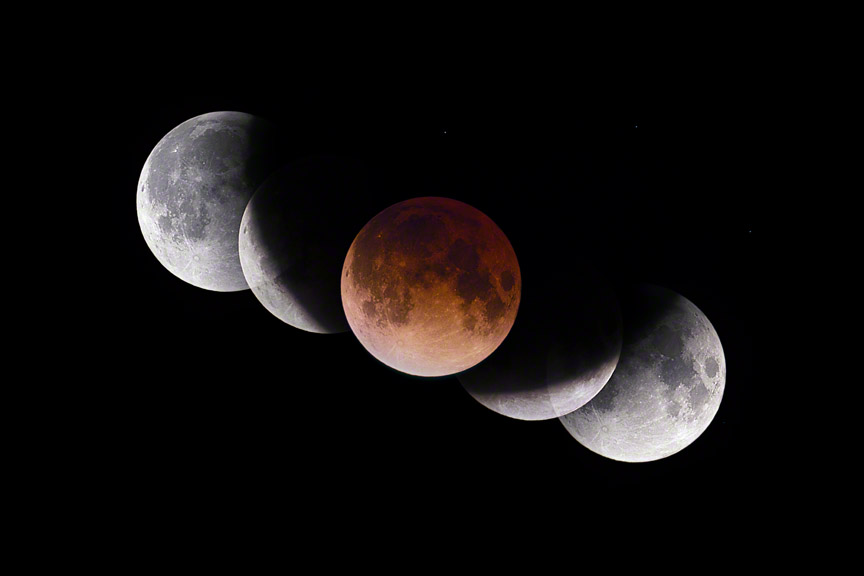
The total lunar eclipse of November 8, 2003. This photo is a composite of 5 images taken 40 minutes apart centered on mid-eclipse at 8:20 p.m. EST. All images of the Moon are positioned relative to the center of Earth's shadow with Earth's north pole up. They are shown at the same scale as the above photo of the 2019 eclipse. A few stars captured during totality can be seen.
Astro-Physics 155mm (6 inch) refractor at f7.1. Each image of the Moon is a stack of two exposures, ranging from 1/500 to 3 seconds on Fuji Provia 400 color slide film centered at 2003-11-08 08:20 p.m. EST, +/- 40 and 80 minutes. All images were taken from northern New Jersey. North is up. ©2003
I had originally intended to make an image of Earth's shadow like the one shown at the top of this page in 2003, using photos of the lunar eclipse of May 15, 2003, which was similar to the 2019 eclipse shown here. Unfortunately, clouds blocked the view in May that year. I photographed the eclipse of December 21, 2010, which was also fairly similar, but at 40 minutes before and after totality the Moon was just on the edge of the Umbra and didn't show the partial phases that I needed to accompany the 2003 photos. Finally, over 15 years later, even though the evening of January 20, 2019 was partly cloudy, I managed to capture the photos I needed between passing clouds to complete the image.
| |||||||||||||||||
|
Astrophotography Books – Astronomy Books |