




| 
|
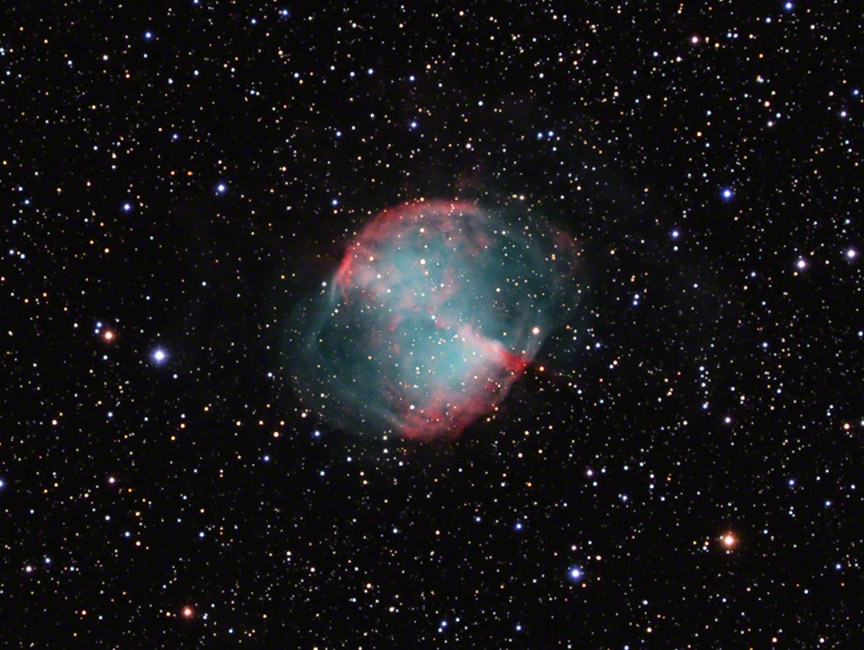
The Dumbbell Nebula, M27, appears high overhead on autumn evenings in the northern hemisphere in the constellation Vulpecula (the "little fox") near the base of the Northern Cross close to the central axis of the Milky Way. The Dumbbell Nebula is about 1200 light-years away. This image shows the bright central portion of the nebula. The image below shows the faint outer regions as well.
Planetary nebulae are glowing clouds of gas and plasma formed by some stars when they die. Most stars produce energy for most of their lives by fusing hydrogen to form helium in their cores. When the hydrogen runs out, gravity compresses the core, heating it until it gets hot enough to fuse helium to form carbon and oxygen. The hotter core heats the entire star, making it expand in violent pulses. The pulses throw the star's outer layers off into space, exposing hotter deep layers that emit ultraviolet light. The strong ultraviolet light from the star ionizes the ejected layers, making them emit light as a glowing nebula surrounding the dying star. After a relatively brief 10,000 - 20,000 years, the central star cools to the point that it stops emitting enough UV to ionize the nebula and the nebula stops glowing, becoming invisible.
136 minutes L and 120 minutes RGB on 2012-09-11 and 2012-09-12 using a QSI 583 from northern New Jersey through an Astro-Physics 155mm refractor at f7.1. North is up. Photographed from northern New Jersey. ©2012
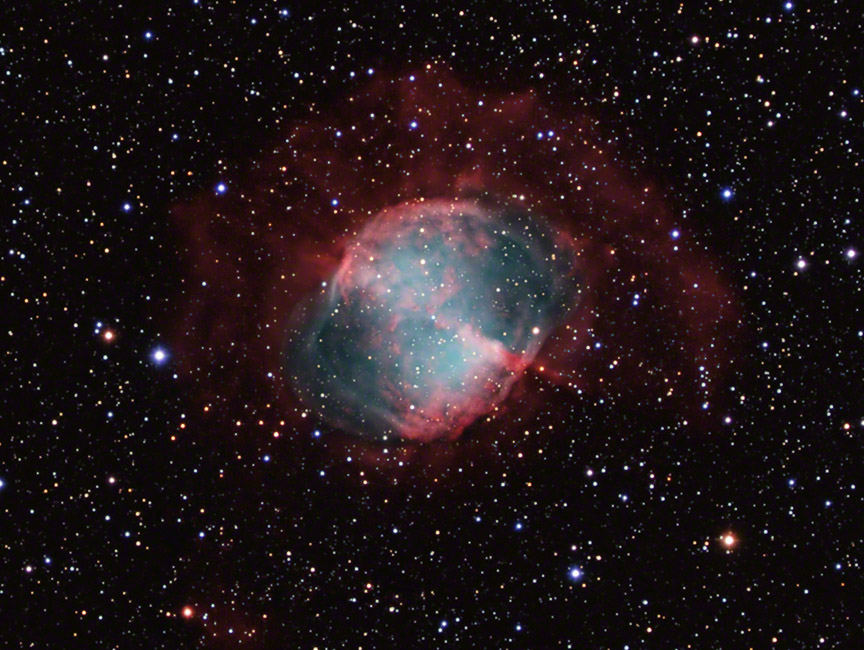
This image shows the extremely dim outer regions of the Dumbbell nebula. It combines the above image with an image taken in Hydrogen-alpha light, shown below.
136 minutes L and 120 minutes RGB on 2012-09-11 and 2012-09-12 plus 240 minutes through an Astrodon 3 nm H-a filter on 2012-09-12 using a QSI 583 from northern New Jersey through an Astro-Physics 155mm refractor at f7.1. North is up. ©2012
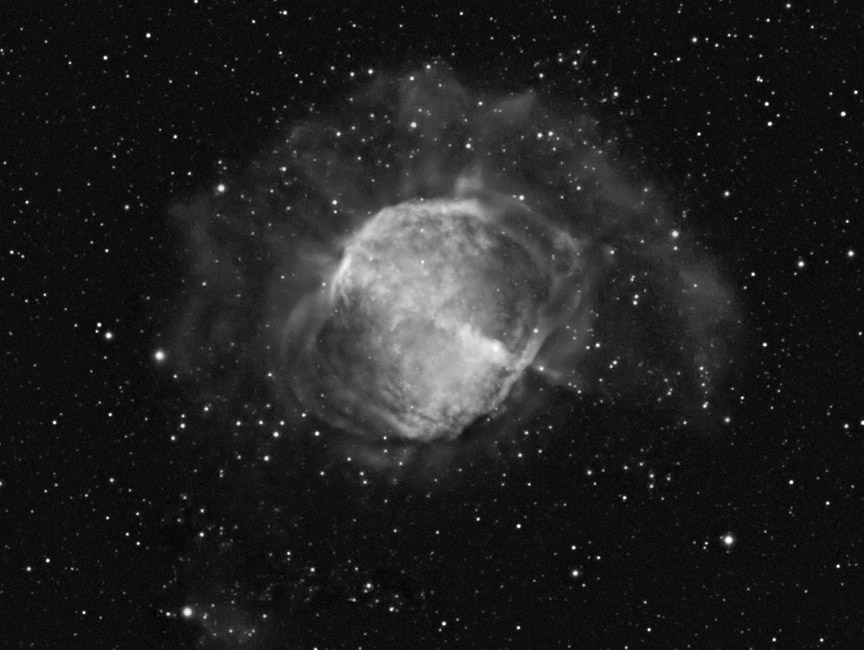
This is a narrowband image of the Dumbbell Nebula taken in Hydrogen-alpha light. It has been processed to show the bright core of the nebula along with the extremely dim outer regions.
240 minutes through an Astrodon 3 nm H-a filter on 2012-09-12 using a QSI 583 from northern New Jersey through an Astro-Physics 155mm refractor at f7.1. North is up. ©2012
| |||||||||||||||||
|
Astrophotography Books – Astronomy Books |