




| 
|
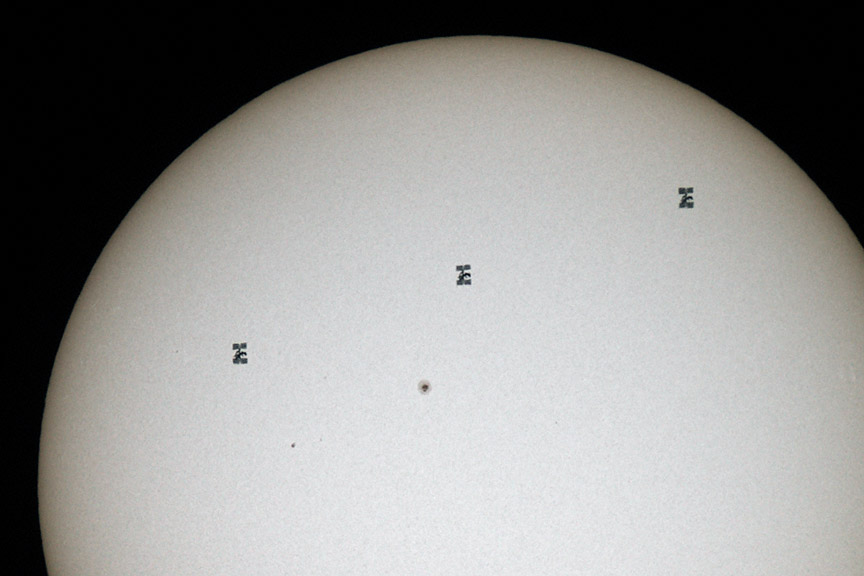
The International Space Station and space shuttle Atlantis transiting the sun as seen from Laurie Field in Haskell, NJ on July 16, 2011 at 3:32:23 p.m. EDT. The above image is a combination of three exposures that were separated by 0.2 seconds. ISS was roughly 300 miles away moving from upper right to lower left. The entire transit took ½ second. Several sunspots are visible on the sun, including a fairly large one below and to the left of center. The image below shows more detail of ISS and Atlantis.
Astro Physics 155mm refractor at f7.1, Baader AstroSolar solar filter material, and a Canon 40D at ASA 200. Three 1/3,200 second exposures centered at 3:32:23 p.m. EDT on July 16, 2011. Photographed from Laurie Field in Haskell, NJ. North is up. ©2011
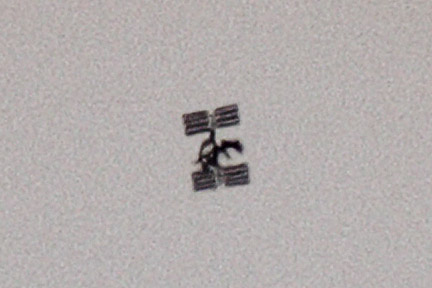
Above is a detail assembled from the same three exposures as the above image of ISS & Atlantis transiting the sun. Atlantis was docked at the International Space Station during the last shuttle mission. The four large rectangular shapes are ISS's main solar arrays. Atlantis is the large shape centered between the solar arrays on the right. Its nose is pointing to the left and its delta-shaped wings are visible on the right.
Astro Physics 155mm refractor at f7.1, Baader AstroSolar solar filter material, and a Canon 40D at ASA 200. Three 1/3,200 second exposures centered at 3:32:23 p.m. EDT on July 16, 2011. Photographed from Laurie Field in Haskell, NJ. North is up. ©2011
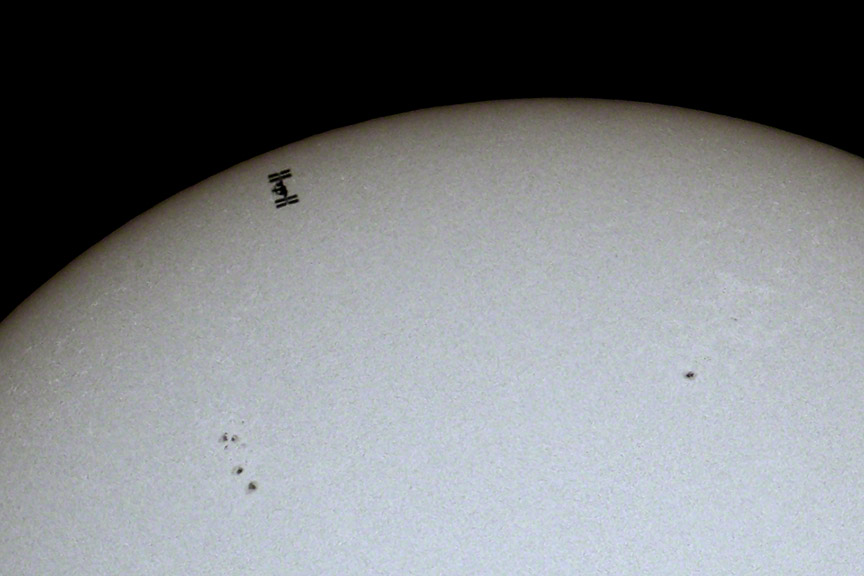
The International Space Station transiting the sun as seen from my home in northern New Jersey on August 21, 2013. The track barely crossed the edge of the Sun, moving to the right and up. The next image I took, approximately 0.16 seconds later (not shown here), caught the ISS partially on the Sun's edge.
A single 1/1000 second exposure at ASA 100 and f7.1 on 2013-08-21 using a Canon 40D from northern New Jersey through an Astro-Physics 155mm refractor and Baader AstroSolar solar filter material. North is to the right. ©2013.
| |||||||||||||||||
|
Astrophotography Books – Astronomy Books |